
Gemini 4 Carbon is Google’s frontier model for complex software engineering, multimodal knowledge work, and scientific reasoning, with a 1M context and 65K tokens of default synchronous output. Its strengths are long-horizon agents, multimodal documents, and security tasks; its weaknesses are higher thinking-token usage and latency, and some coding benchmarks still trail Claude Opus 5.5. The API is $2/$10 through November 30, 2026, reverting to $4/$20 from December 1 — well suited to high-value complex tasks first, not recommended as the default for every request before you’ve measured the cost.
Key takeaways
- Gemini 4 Carbon was announced October 28 and became broadly available November 10 — two different dates for launch and availability; don’t conflate them.
- Total context is 1,048,576 tokens shared by input, thinking, and output; default synchronous output is 65,536, and long decodes need background execution.
- Artificial Analysis currently lists 60 points, #4/74; its October 29 article recorded 59 and #1 — leaderboards move with versions.
- Several coding benchmarks trail Claude Opus 5.5; AA-Omniscience leads, but hallucination rose from Argon’s 4% to 11%.
- Output pricing counts thinking tokens plus visible output; run complex tasks in the background and raise
max_output_tokens. - In a user-supplied HSS chart, Carbon (agent) shows 82.2, but no public source has been found; other key values in the chart were cross-checked against Scale’s official leaderboard.
- As of November 11, API Hop has not listed Carbon, so this review has no site-routing latency or success-rate measurements.
Background: where Carbon comes from
Google announced Gemini 4 Carbon on October 28, 2026, initially limited to some cyber-defense personnel and the Fairwind Program; on November 10 it expanded to Gemini API paid tiers, AI Studio, Android Studio, Antigravity, and enterprise and consumer channels. It sits above Gemini 4 Argon, officially positioned as the series’ strongest reasoning model for complex software engineering, multimodal knowledge work, scientific reasoning, and cyber defense.
This review separates evidence into four classes: Google’s official docs, third-party benchmarks from Artificial Analysis and Scale AI, Hacker News community experience, and the user-supplied HSS chart. The classes are not mixed — official marketing, third-party scores, and individual anecdotes never become one conclusion.
What we know vs. what we don’t
| Item | Current evidence | How it can be stated |
|---|---|---|
| Model ID & 1M context | Official | gemini-4-carbon, total context 1,048,576 tokens |
| Default & long-decode output | Official | 65,536 default; up to 1M via background with a raised limit |
| Price & promo end date | Official | $2/$10 through Nov 30; $4/$20 from Dec 1 |
| Aggregate & per-category scores | Third party: Artificial Analysis | Currently 60, #4/74; second in some coding categories |
| Most HSS values | Third party: Scale AI | Human 93.1, Argon 55.4, Astra 53.6 cross-verified |
| Carbon (agent) 82.2 | User-supplied image, no public source found | Present as unverified; not an official conclusion |
| Usage experience & quotas | Individual HN reports | Shows speed/quota/channel discussions exist; no extrapolation |
| Parameter count, MoE structure | Not public | No parameter guesses, no invented architecture |
| API Hop support status | Site pricing page not listing it on 11-11 | No support claimed; no site measurements |
Architecture analysis: public mechanisms beat parameter rumors
Google hasn’t published Carbon’s parameter count or MoE details, so this review doesn’t discuss unverified “X-billion-parameter” claims. What actually shapes integration cost and experience are four published mechanisms.
The 1M context is a total budget, not extra space
Input, thinking, and output share 1,048,576 tokens. Default synchronous output caps at 65,536; longer output requires background: true plus raising max_output_tokens above 65K. Enabling background without raising the limit still stops near 64K.
Analyzing a large codebase can use the long context, but reserve room for reasoning and the final answer. max_output_tokens caps the thinking-plus-output total, not just the visible answer.
Thinking levels directly shape latency and bills
Carbon offers low, medium, and high; medium is default. Google explicitly warns that higher thinking levels usually consume more tokens with higher latency, and Carbon already burns more thinking tokens than Argon.
For interactive coding or response speed, Argon remains sensible. Carbon fits complex debugging, deep research, and multi-stage verification that are worth the wait.
Multimodal input and the toolchain are the core differentiators
Carbon accepts text, image, video, audio, and PDF input with text output, and supports code execution, computer use, file search, function calling, Google Search/Maps grounding, and structured output. It does not support audio generation, image generation, or the Live API — don’t fold those into conclusions.
Caching and long-task calling need adjustments
Carbon supports implicit caching only — no cachedContents or caches.create explicit usage. Complex tasks should run in the background with HTTP timeouts of at least 15 minutes; long decodes also need stitching multiple model_output steps. Migrating an existing app, these matter more than swapping the model name.
Benchmark analysis: what leads and what doesn’t
Separate official and AA data
Google’s announcement cites SEC-bench Pro 88.2%, ExploitGym 54.8%, CWE-bench 71.0%, and WebDev Arena 1768 Elo. They show where Google invested — security and engineering — but should be read alongside third-party tests.
Artificial Analysis adds nuance:
| Benchmark | Carbon’s result | Context and boundary |
|---|---|---|
| Intelligence Index | Currently 60, #4/74 | Oct 29 article recorded 59, #1; the board has changed |
| Coding Agent Index | 59, second | Claude Code + Opus 5.5 (max) at 62 |
| Terminal-Bench 4.0 | 64%, second | Behind Claude Opus 5.5 |
| FrontierCode | 51%, second | Opus 5.5 (max) at 56% |
| AA-Omniscience | 54, first | Opus 5.5 at 48, Argon at 46 |
| AA-Briefcase | 1609 Elo | Below Grok 4.7, Muse Wonder, Kimi K3.1 Pro |
| Hallucination rate | 11% | Above Argon’s 4%; still a low tier, but not “least hallucinating” |
Overall, Carbon stands out on aggregate ability and some knowledge work, but several coding and knowledge-work categories have clear rivals.
The user-supplied HSS chart: how to read it
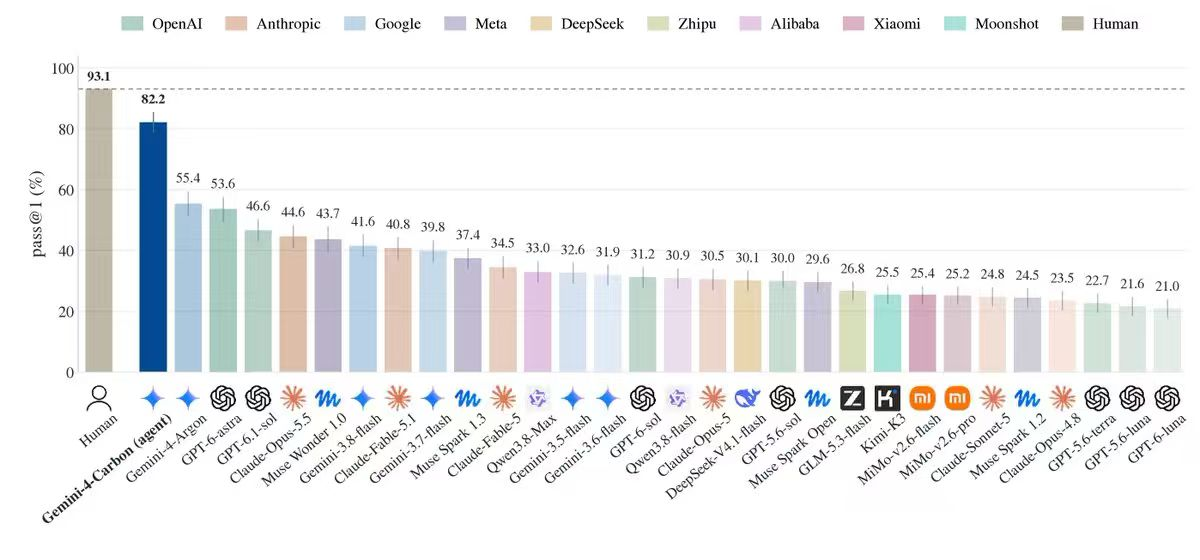
Caption: user-supplied HSS leaderboard screenshot. Human 93.1, Gemini 4 Argon 55.4, and GPT-6 Astra 53.6 were cross-verified against Scale AI’s official leaderboard; the source of Gemini 4 Carbon (agent) 82.2 has not been found — add a source before citing it.
The chart comes from Scale AI’s HSS (Humanity’s Sixth Sense) evaluation, testing how models infer non-obvious information from images or silent video — event causality, spatial and social relations, and abstract structure. It is not a general-intelligence board and not a coding board.
The official HSS has 522 tasks — 288 images and 234 silent videos — across 4 domains and 11 subdomains. pass@1 is the share of correct attempts averaged across tasks; each item runs 3 times, and an answer passes only if it meets every scoring criterion. Error bars are half-widths of 95% cluster-bootstrap intervals; overlapping intervals shouldn’t be over-read as fine rank differences.
Three layers stand out:
- Human at 93.1. That’s the human annotators’ accuracy — a human-machine reference point, not a model ceiling.
- Argon at 55.4 and GPT-6 Astra at 53.6, matching Scale’s current board — these intuitively easy visual-inference tasks remain hard for ordinary model calls.
- Carbon (agent) marked 82.2. If the original leaderboard confirms it, that’s +26.8 points over Argon, +28.6 over Astra, and −10.9 below Human. Striking — but 82.2 can’t be treated as verified today.
Note the “agent” label: it may mean visual operations, tool calls, or a multi-step verification scaffold outside the model. Without a public agent configuration, there’s no way to split gains between model and scaffolding. On current evidence the chart supports “agentic visual reasoning deserves verification” — not “Carbon approaches human general intelligence.”
Real-world API performance: speed, latency, cost
As of November 11, API Hop hasn’t listed Carbon, so this review offers no fabricated site-routing measurements. The citable third-party data is from Artificial Analysis:
| Metric | Carbon’s result | Assessment |
|---|---|---|
| Output speed | 80 tokens/s | Generation phase only; not full task time |
| First-token latency | 67.08 s | Includes reasoning wait; hurts interactive use |
| Time per Index task | 25.6 min | Above the 12.6-min peer median; fits background jobs |
| Cost per Index task | $7.76 | Specific benchmark scope, not an all-task average |
| Index output volume | 205M tokens | Above the 72.8M median; long output drives cost |
Google also warns that complex questions can take minutes and recommends background execution or long HTTP timeouts. In HN threads, users debate Carbon/Argon speed and quota burn, and some Ultra users report better Antigravity experiences. These anecdotes don’t replace unified measurement but flag channel, quota, and toolchain variance.
Pricing analysis: limited-time cheap isn’t long-term cheap
Official prices, per million tokens; output pricing includes thinking tokens:
| Tier | Item | Through 2026-11-30 | From 2026-12-01 |
|---|---|---|---|
| Standard | Input / output | $2 / $10 | $4 / $20 |
| Standard | Implicit cache-hit input | $0.10 | $0.20 |
| Batch / Flex | Input / output | $1 / $5 | $2 / $10 |
| Batch / Flex | Implicit cache-hit input | $0.05 | $0.10 |
| Priority | Input / output | $3.60 / $18 | $7.20 / $36 |
| Priority | Implicit cache-hit input | $0.18 | $0.36 |
A cache-free Standard estimate: 100K input + 20K output tokens costs $0.20 + $0.20 = $0.40 before November 30 and $0.40 + $0.40 = $0.80 after December 1. Batch-qualified, the same usage is $0.20 during the promo. Extra thinking, search grounding, retries, and tool calls aren’t included; real bills can be higher.
AA estimates Carbon’s Index task cost at $7.76 — below Claude Opus 5.5’s $10.04, above GPT-6 Astra’s $6.25. That comparison holds only for AA’s tasks and output volumes; it doesn’t prove Carbon cheaper everywhere.
Limitations and open questions
- Noticeable interactive latency: the 67.08-second first-token wait and 25.6-minute task time come from specific AA runs, but they already disqualify it as a blind default for interactive work.
- Some coding categories trail: Coding Agent Index, Terminal-Bench, and FrontierCode all have Claude Opus 5.5 ahead.
- Hallucination isn’t just about ranking: Carbon leads AA-Omniscience, but its 11% hallucination rate exceeds Argon’s 4% — evaluate knowledge and honesty separately.
- Long output complicates integration: background execution, output caps, segment stitching, and timeouts all need rework; a model-ID swap isn’t enough.
- No free API tier: consumer availability involves Ultra subscriptions, channels, and quotas — confirm your account includes Carbon before trialing.
- The HSS 82.2 source is open: until the original link surfaces or officials update, the number isn’t a decision-grade input.
What builders should do today
- Prefer
background: truefor complex debugging and deep research, with HTTP timeouts of at least 15 minutes. - Raise
max_output_tokenswhen long output is needed; official examples for complex tasks use 131,072 or 262,144 tokens. - When migrating, drop
temperature,top_p,top_k, and explicit cache configuration to avoid invalid or erroring parameters. - Use
previous_interaction_idfor multi-turn and function calling to keep server-side state, and stitch step outputs after long decodes finish. - Start at the medium thinking level; enable high per task only when regression tests show a real success-rate gain.
- Track cost per successful task — separately record thinking tokens, tool calls, search grounding, and failed retries.
How to evaluate it yourself
Building a control group from your real tasks beats copying public benchmarks. Cover at least long-document analysis, cross-file coding, multi-step tool calls, and visual-material understanding, and keep past failure samples.
Fix input, tools, thinking level, and output caps per test; record success rate, first-token latency, total time, thinking tokens, visible output tokens, and retries. Comparing Carbon against Argon or Claude Opus 5.5, keep the toolchain identical so agent-framework differences don’t masquerade as model capability.
What to watch next
- The December 1 price switch: Standard input/output doubles; re-base long-term budgets on $4/$20.
- Real coding and research outcomes: watch long-task completion and human takeovers, not just new leaderboard ranks.
- HSS chart updates: if Scale or Google publishes the Carbon agent configuration and the original 82.2 result, update the chart’s conclusions.
- API Hop listing: once Carbon is supported, add same-region, same-task routing latency and success-rate measurements, and refresh the updated date.
FAQ
Is Gemini 4 Carbon worth integrating?
If your workload includes complex codebase debugging, multimodal document analysis, or multi-step research, a small-scale test is worthwhile. For low-latency Q&A or simple classification, faster and cheaper models like Argon may fit better — your regression results decide.
Is Gemini 4 Carbon free?
The Gemini API has no free tier. Consumer availability ties to subscriptions like Google AI Ultra; quotas vary by account, region, and channel — subscription perks aren’t API credits.
Gemini 4 Carbon or Claude Opus 5.5 — which is stronger?
No single answer. Carbon leads on AA-Omniscience; Opus 5.5 leads Coding Agent Index, Terminal-Bench, and FrontierCode. Test both on your task types, toolchain, and cost.
What’s Gemini 4 Carbon’s maximum output?
Default synchronous output is 65,536 tokens. With background long-decode and a raised max_output_tokens, up to 1M tokens — but input, thinking, and output still share the 1M total context.
Is Gemini 4 Carbon’s HSS 82.2 an official score?
It can’t be confirmed. The user-supplied image shows 82.2, but no such result appears in Scale’s current public leaderboard or Google’s announcements. Human 93.1, Argon 55.4, and Astra 53.6 are verified; 82.2 needs an original source before it’s cited as fact.
Is Gemini 4 Carbon suitable as a real-time coding assistant?
Depends on the task. Google states Carbon consumes more thinking tokens with higher latency than Argon; try Argon first for completions and interactive edits, Carbon for complex debugging and long verification loops.
Information verified 2026-11-11: Google announcement (Introducing Gemini 4 Carbon, 2026-10-28) · Google announcement (Gemini 4 Carbon Now Available, 2026-11-10) · Gemini API model details · Gemini API pricing · Artificial Analysis (third party) · Scale AI HSS leaderboard. Benchmarks, prices, channels, and capabilities may change; Google’s latest docs rule. The API Hop pricing page did not list Carbon as of 2026-11-11.